
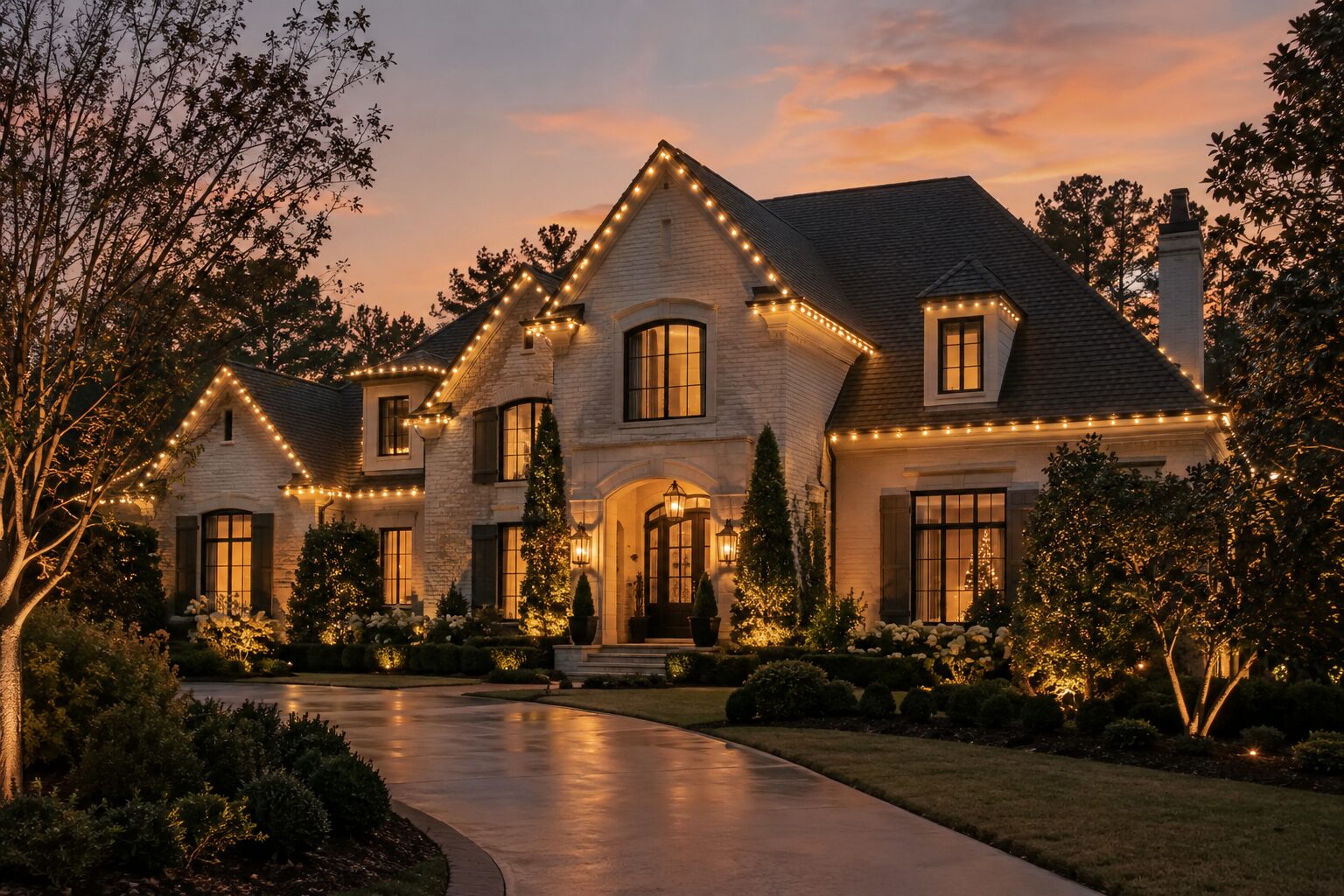
Every November, somebody stands on a ladder in the cold and staples lights to your fascia. Every January, somebody takes them down. You pay both times, and in between you own a box of tangled light strings in the garage.
There’s another way to do it now, and the question is whether it’s worth the up-front number. Here’s the honest comparison.
Quick Answer: Permanent vs. Seasonal at a Glance
| Permanent holiday lighting | Annual seasonal installation | |
|---|---|---|
| Up-front cost | Substantially higher — it’s an installation, not a service | Low per season |
| Recurring cost | None for install; electricity and occasional service only | Every year, install and removal, typically rising |
| Where it lives | Mounted flush to the fascia or soffit, permanently | Clipped or stapled on, removed each January |
| Visible in daylight when off | Barely — a thin channel that reads as trim | Nothing, once removed |
| Usable outside December | Yes — any color, any holiday, game days, parties, everyday warm white | No |
| Control | App or wall control; scenes and schedules | Whatever the strings do |
| Ladder work each year | None | Twice |
| Fascia wear | One mounting, done properly, once | New staples or clips into the same fascia every year |
| Warranty | 5-year manufacturer’s warranty on the LEDs | Not applicable |
| HOA considerations | Real — permanently mounted, so check first | Usually governed by seasonal display rules only |
| Breaks even | After a number of seasons — see the model below | Never; it’s a rental |
How the Five-Year Math Actually Works
This is the whole decision, so it’s worth doing properly rather than asserting a number.
Seasonal installation is a recurring cost. You pay for labor, ladder time, and the strings themselves, plus removal. Prices in the Atlanta metro are driven by roof height, roofline complexity, and how early you book — November pricing is not September pricing. Because it’s labor, it tracks wage inflation upward year over year, and the strings degrade and get replaced.
Permanent lighting is a capital cost with near-zero recurring cost. You pay once for the channel, the LEDs, the controller, and the electrical work. After that you pay for electricity — low, because it’s LED — and occasional service.
So the comparison is:
Seasonal 5-year total  =  (install + removal per season) × 5, adjusted upward for annual price increases
                          + string replacement
                          + your own time booking and supervising it twice a year

Permanent 5-year total =  one-time installed cost
                          + 5 years of LED electricity (minimal)
                          + any service outside the 5-year warranty (bulb replacement inside it
                            is covered with no service charge)
Ask us for both numbers on your actual roofline and we’ll do this arithmetic with you in front of the house. We’re not going to publish a break-even year as though every house is the same one — a single-story ranch in Canton and a three-gable two-story in Milton have completely different seasonal labor costs, which is the variable that decides it.
What we will say: the more complex and the taller your roofline, the faster permanent wins. Seasonal pricing punishes exactly the houses that look best lit.
What Permanent Lighting Actually Looks Like
The objection we hear most is “I don’t want a Christmas light track on my house in April.”
Fair. Here’s the reality. The channel is a slim aluminum track mounted flush under the eave or along the fascia, color-matched to the trim. From the street in daylight it reads as a shadow line. It is not invisible — anyone who tells you it’s invisible is selling — but it’s closer to a gutter edge than to a decoration.
The LEDs sit inside the channel, facing out, so you see light on the house rather than a row of bulbs. That’s the actual quality difference from strings: strings show you the source, channel systems show you the effect. It’s the same principle as glare shielding in landscape lighting.
The Part Nobody Mentions: You’ll Use It in July
People buy this for December and then use it year-round, which changes the value calculation entirely.
- Everyday — a single warm white scene at low output. Most owners land here and leave it. It functions as permanent architectural accent lighting.
- Holidays — red and green in December, orange for Halloween, red white and blue in July, pastels at Easter.
- Game days — this one gets used more than any of the others in Georgia.
- Parties and events — a scene for the evening.
- Security — a lit facade at low output all night.
If you only ever use it for six weeks a year, the math is harder. Most people don’t.
Where Seasonal Installation Is Still the Right Call
We’d rather tell you this than sell you the wrong thing.
Choose seasonal if:
- You’re planning to sell within a couple of years and won’t recover the capital
- Your HOA prohibits permanently mounted facade fixtures — check before anything else
- Your fascia or soffit needs repair or replacement first; mounting to bad substrate is throwing money away
- You genuinely only want lights in December and won’t touch the app otherwise
- Your display is mostly trees, wreaths, and ground decor rather than roofline
Choose permanent if:
- You’ve paid for seasonal installation three years running and expect to keep doing it
- Your roofline is tall or complex, which is exactly what makes seasonal labor expensive
- You want the roofline lit outside December
- You’re done with ladders, scheduling, and January takedown
- You’re already re-doing the exterior and the electrical work can ride along
The HOA Question, Answered Honestly
This is the single most common reason a permanent-lighting project stops, and it’s worth handling first rather than last.
Permanently mounted facade fixtures fall under architectural review in many Cherokee County and north Atlanta subdivisions, and the rules genuinely vary between neighborhoods — sometimes between phases of the same neighborhood. Some prohibit visible channel entirely. Some allow it in a trim-matched color. Some regulate only what colors may be displayed and when, which is the easier version.
We can’t tell you what your HOA says, and we won’t guess. Get it in writing before you book. What we can do is give you the fixture specification, mounting detail, and color-match documentation that architectural committees ask for, which is usually what stalls an application.
Installation: What Each One Involves
Seasonal
A crew arrives, measures, clips or staples strings along the roofline, plugs into an existing exterior outlet or a temporary run, and leaves. One to a few hours depending on the house. Reverse it in January.
Permanent
Closer to a real electrical install. Channel is measured and cut to the roofline, mounted flush to fascia or soffit, LEDs seated, controller wired and connected, and the whole system commissioned and programmed with you. It’s licensed electrical work — ours is done under license EN008650, by our own people. We don’t subcontract any of it.
Our sequence, so you can plan around it: callback within 1–2 business days, consultation typically within 3 days, 50% deposit on signing, installation begins within 7–10 days. Which is precisely why September and October are when this gets booked, not late November.
A Word on Fixture Quality
Permanent lighting is having a moment, and a lot of very cheap systems have arrived with it. The failure modes are consistent: plastic channel that chalks and yellows in Georgia sun within two seasons, LEDs that shift color unevenly as some diodes age faster than others, controllers with an app that stops being supported, and sealing that lets August rain into the channel.
You are mounting this to your house permanently. The whole argument for it is that you stop paying every year — which only holds if it lasts. Ask what the channel is made of, ask what the warranty covers and who honors it, and ask who does the electrical work.
Ours carries a 5-year manufacturer’s warranty on the LEDs, bulb replacement inside that warranty carries no service charge, and you deal with us rather than a manufacturer’s call center.
Where to Go From Here
If you want it for this December, now is the booking window — not November. See our permanent holiday lighting page for the service detail, or our roundup of the best permanent holiday lights for 2026 if you’re still comparing systems.
Better still: ask us to walk the property at dusk and quote you both options on your actual roofline. That’s the only version of this comparison with your numbers in it. Get in touch — or call 678-203-6389. We’re at 775 Ash St in Canton, and we’ve been doing this since 1998.
Frequently Asked Questions
Are permanent holiday lights worth it compared to hiring installers every year?
It depends on how many more seasons you expect to pay for installation and how complex your roofline is. Permanent lighting is a one-time cost with almost no recurring cost; seasonal installation is a recurring cost that rises with labor rates. The taller and more complex the roofline, the faster permanent lighting pays back — because roofline complexity is what makes seasonal labor expensive.
Can you see permanent holiday lights during the day?
Slightly. The channel is a slim aluminum track mounted flush under the eave and color-matched to the trim, so from the street in daylight it reads as a shadow line similar to a gutter edge. It is not invisible, and anyone claiming otherwise is overselling it.
Do permanent holiday lights work for occasions other than Christmas?
Yes, and that’s where most of the value ends up. The systems are full-color and app-controlled, so the same install covers everyday warm white accent lighting, Halloween, July 4th, Easter, game days, and parties.
Will my HOA allow permanent holiday lighting?
It varies by subdivision, sometimes between phases of the same subdivision. Permanently mounted facade fixtures often fall under architectural review in Cherokee County and north Atlanta neighborhoods. Get written approval before booking. NightVision can supply the fixture specification, mounting detail, and color-match documentation architectural committees typically request.
How long does permanent holiday lighting installation take, and when should I book?
NightVision calls back within 1–2 business days, schedules a consultation typically within 3 days, and begins installation within 7–10 days of a signed contract with a 50% deposit. For a December display, book in September or October — November is the industry’s peak and the schedule fills.
What warranty comes with permanent holiday lighting?
A 5-year manufacturer’s warranty on the LEDs. Bulb replacement inside the warranty carries no service charge, and the customer deals with NightVision directly rather than the manufacturer. Installation is performed in-house under electrical license EN008650 and is never subcontracted.
Does permanent lighting damage your fascia?
Properly installed, it’s mounted once to sound substrate. Annual seasonal installation puts new staples or clips into the same fascia every year, which is generally harder on it over a decade. If your fascia or soffit needs repair, that work should happen before any permanent mounting.