
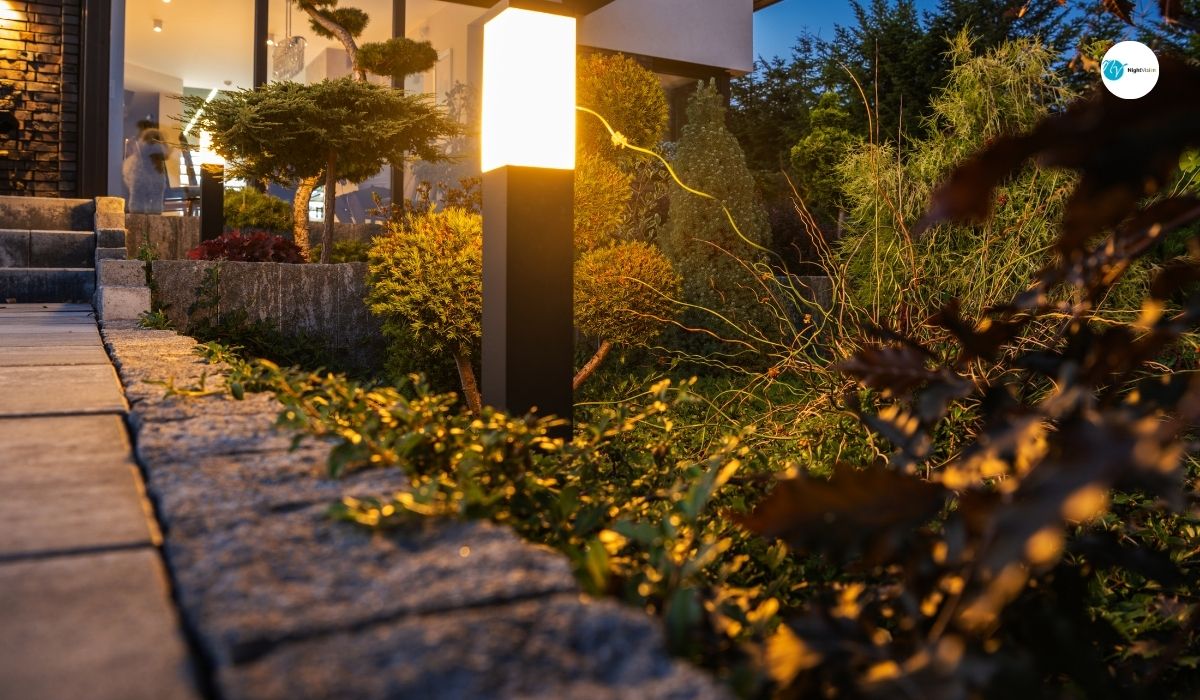
A low-voltage outdoor lighting system is generally best served by a professional visit about once a year. That visit is mostly four things: re-aiming fixtures that trees and shrubs have grown past, cleaning lenses that have gone cloudy with pollen and red clay dust, checking transformer voltage at the far end of each run, and replacing the bulbs that have started to drift in color. Most systems that “stop working” were never maintained, not badly installed.
Quick Answer
| Question | Short answer |
|---|---|
| How often? | Once a year suits most residential systems. Twice a year is the usual recommendation if you have heavy tree cover or an irrigation system that sprays fixtures. |
| What does a visit cover? | Re-aiming, lens cleaning, voltage check at each run’s end, connection inspection, bulb replacement, transformer timer and photocell reset. |
| Who should do it? | Someone who can read voltage drop. NightVision’s crew is supervised by a master electrician (license EN008650) and we do not subcontract. |
| What does it cost? | It depends on fixture count, run length and how long it has been. Ask for a quote — we don’t publish a flat rate, because a 12-fixture front yard and a 60-fixture property are not the same job. |
| Bulbs under warranty? | Our LED fixtures carry a 5-year manufacturer’s warranty, and we replace bulbs covered by it with no service charge. |
| How fast can you come out? | Service calls are addressed within 3 days to a week. We group them geographically, so the closer you are to Canton, the sooner. |
What annual maintenance actually involves
People picture bulb changes. Bulb changes are maybe a fifth of it.
Re-aiming
This is the one that matters most and the one nobody thinks about. A fixture aimed at a six-foot Japanese maple in 2021 is aimed at the trunk of a nine-foot Japanese maple now. The light still works. It just isn’t lighting anything you wanted lit. On a property with mature hardwoods, a meaningful share of the fixtures will need some adjustment each year.
Lens cleaning
North Georgia gives you two problems at once. Spring pollen films every horizontal surface for weeks, and red clay dust kicks up off driveways and beds all summer. A clouded lens can cut usable output noticeably before anyone consciously notices the yard looks dimmer. They don’t think “the lens is dirty.” They think “these lights aren’t as good as they used to be.”
Voltage check at the end of each run
A 12-volt system is only 12 volts at the transformer. By the last fixture on a long run it might be 10.2, and at 10.2 an LED shifts color and a halogen goes visibly orange. We meter at the far end, not at the box. If the reading has drifted since install, something has changed — a connection has corroded, or someone added fixtures to a run that was already at its limit.
Connections
Buried connections are where systems die. Water finds the one that wasn’t sealed properly, copper corrodes, and the run beyond it goes dark months later. We pull and inspect the ones that matter.
Bulb replacement and color matching
LEDs don’t burn out so much as drift. One fixture at 3200K next to five at 3000K reads as “that one looks wrong” even to someone who couldn’t tell you why. We replace in groups for that reason, not one at a time.
How often, honestly
| Your property | Typical interval | Why |
|---|---|---|
| Open yard, few trees, under 20 fixtures | Once a year | Little growth interference; mostly cleaning and a voltage check |
| Mature hardwood canopy | Once a year, with a larger re-aiming budget | Canopy height changes measurably year to year |
| Irrigation spraying across fixtures | Twice a year | Mineral deposits on lenses build fast, and heads shift fixture aim |
| Commercial property or HOA common area | Twice a year | Higher fixture counts, longer runs, more public-facing consequence when one zone is dark |
| System over 10 years old on halogen | Assessment first, then decide | At some point maintenance stops being the right spend and conversion to LED is |
The five failures we see most
| What you’ll notice | What it usually is | Maintenance or repair? |
|---|---|---|
| One zone dark, rest fine | A corroded buried connection, or a run that has drifted below usable voltage | Repair — but annual metering catches it before it goes dark |
| Everything looks dimmer than it used to | Clouded lenses, often all of them at once | Maintenance |
| Lights come on at the wrong time | Photocell blocked by growth, or a timer that drifted after a power cut | Maintenance |
| Light is landing on nothing | Plant growth; the fixture is fine | Maintenance |
| One fixture is a different color | An LED that has drifted, or a mismatched replacement bulb | Maintenance |
Mistakes homeowners make with maintenance
| Mistake | What it costs you |
|---|---|
| Waiting until something goes dark | By then the connection has been corroding for a year and the repair is a dig, not a wipe |
| Replacing one bulb at a time with whatever the hardware store has | A yard with four color temperatures in it |
| Pressure-washing fixtures | Driving water past the gasket, which is how a sealed fixture stops being sealed |
| Letting the landscaper “adjust” fixtures | Aim without a voltage reading is guesswork, and mulch piled over a fixture cooks it |
| Assuming the warranty covers it | A manufacturer’s warranty covers the fixture, not the pollen on it |
What we do differently
Every visit is done by NightVision’s own crew. We have never subcontracted installation or service — the person metering your transformer works here. Our work is supervised by a master electrician, Walter Taylor, under Georgia electrical license EN008650. We have been lighting North Atlanta properties since 1998 and have lit more than 5,000 homes.
We also keep a crew dedicated entirely to post-installation service, which is why a service call gets looked at in 3 days to a week rather than whenever an install crew has a gap.
Ask us to walk your property at dusk — that’s when you can actually see what a year of growth has done to the aim.
Related questions
Do I need maintenance if my system is all LED?
Yes. LEDs last longer, which means the fixture outlives more seasons of growth, dirt and ground movement than a halogen one ever did. The bulbs need less attention; everything around them needs the same amount.
Can I do any of it myself?
Wiping lenses with a soft cloth and plain water, yes, and it helps. Re-aiming without checking what it does to the whole composition, and anything involving a buried connection, no.
What if my system was installed by someone else?
We maintain systems we didn’t install. We’ll tell you honestly if the original design has problems we can’t fix with a service visit.
Is there an annual plan?
Yes — we offer an optional annual maintenance plan. Ask about it when you call.
How quickly can someone come out?
We return calls within 1 to 2 business days, often the same day, and address service calls within 3 days to a week.