
October 2026
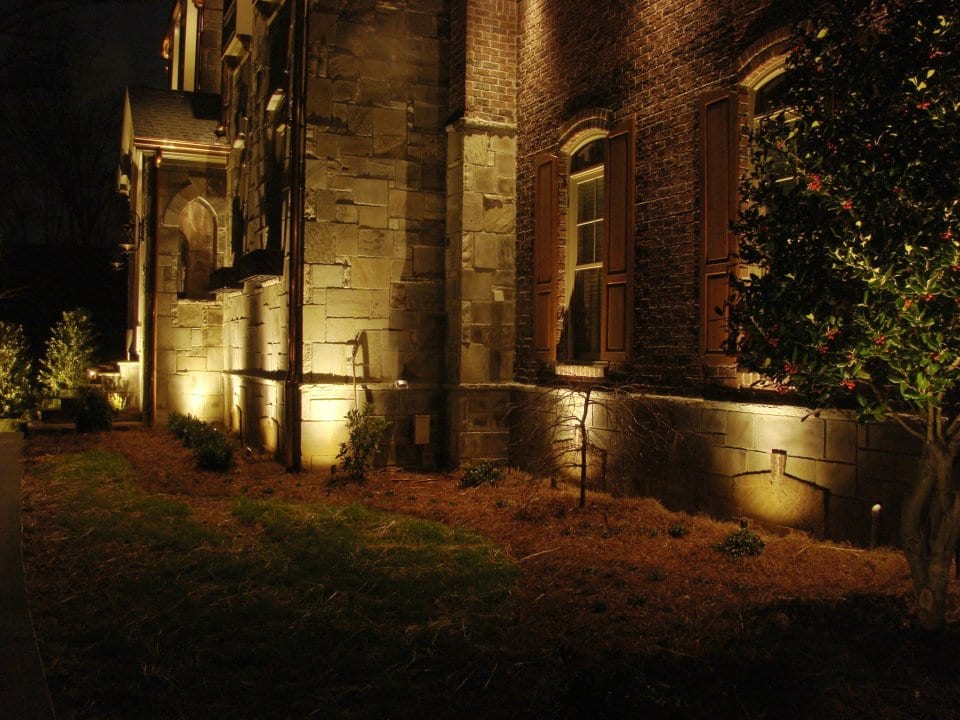
Uplighting puts a fixture at ground level aimed up. Downlighting puts one above — in a tree, under an eave — aimed down. Uplighting is dramatic and makes things look bigger than they are. Downlighting is natural and makes a space usable. Most houses that look right at night use both, and the common mistake is doing only the first.
If you’re choosing one: uplight the house, downlight the places people walk.
Quick Answer
| Question | Short answer |
|---|---|
| What’s uplighting for? | Architecture, tree trunks, columns, texture. Anything you want to look taller and more sculptural. |
| What’s downlighting for? | Patios, paths, steps, seating, driveways. Anywhere a person actually stands. |
| Which is more natural? | Downlighting. Light has come from above for the whole of human history, and the eye knows it. |
| Which causes glare? | Uplighting, by a wide margin, if it isn’t shielded and aimed properly. |
| Which costs more? | Downlighting usually, because getting a fixture 20 feet up a hardwood takes a climber and a careful wire run. |
| Can I have both? | You should. The best exteriors read as one scheme because the two layers are balanced against each other. |
Side by side
| Uplighting | Downlighting | |
|---|---|---|
| Fixture position | At or below grade, aimed up | In a tree, under an eave, on a structure, aimed down |
| Best on | Facades, columns, chimneys, tree trunks, walls with texture | Patios, paths, steps, driveways, seating, planting beds |
| Feels | Dramatic, designed, deliberate | Natural, calm, like moonlight |
| Glare risk | High — a ground fixture is at eye level for anyone walking toward it | Low — the source is above the sightline |
| Light trespass | Higher. Uplight that misses its target goes into the sky or a neighbor’s window. | Lower. Contained by definition. |
| Install difficulty | Straightforward — trenching and a shallow set | Harder — climbing, mounting, and a wire run that has to allow for tree growth |
| Maintenance | Aim drifts with soil movement; lenses collect mulch and clay splash | Needs re-aiming as the canopy rises; less dirt, more access cost |
| Typical cost per fixture installed | Lower | Higher |
| Hurt by overuse | Badly — every surface uplit reads as a theme park | Rarely |
Where each one belongs on a real house
Uplight these
- The facade, selectively. Two or three strong vertical elements — a chimney, a gable, a pair of columns — not the whole front wall evenly.
- Specimen trees, from the trunk. A mature oak uplit from two sides at the base is the single most effective fixture pair on most properties.
- Texture. Stacked stone, old brick, board-and-batten. Raking light across texture is what makes it read at night.
Downlight these
- Anywhere people walk. Steps first, then paths, then the route from the drive to the door.
- Seating and dining. Light on the table, not in the face.
- Beds and lawn, from a height. This is where downlighting earns its keep — a fixture high in a hardwood casting leaf shadow across a lawn is as close as outdoor lighting gets to looking like it isn’t there.
The mistakes
| Mistake | What it looks like |
|---|---|
| Uplighting everything | A commercial building. Pick the two or three elements worth the drama and leave the rest dark. |
| Uplighting with no shielding | A bright source in the eye of everyone walking up your drive. The fixture becomes the thing you see. |
| A row of path lights instead of downlighting | Remember, you’re crafting landscape lighting, not a runway. |
| Downlighting at 3000K to match the house | Moonlight is cool. 4000K out of a tree reads as moonlight; 3000K out of a tree reads as a porch light someone left in a branch. |
| Mounting a tree downlight too low | The spread is too narrow and it looks like a spotlight. Height is most of what makes it work. |
| Hard-fixing a tree mount | The tree grows. Mounts need to allow for that or you’ll be cutting into it in five years. |
Color temperature — the detail that decides it
The two techniques want different light and this is where most DIY schemes fall apart.
- Uplighting on a house: 2700K to 3000K. Warm. It should look like the building is glowing, not being inspected.
- Downlighting from a tree: around 4000K. Cooler. Moonlight is cool-toned, and a cool downlight filtering through leaves is read by the eye as moonlight rather than as a lamp. Use warm light up in a tree and the illusion collapses.
Using one color temperature for both because it seems tidier is the most common specification error we fix.
How we’d approach your property
Walk it at dusk, with you. Uplighting decisions are made by standing where people will stand — at the curb, at the top of the drive, on the patio — and asking what should be the brightest thing in that view. Downlighting decisions are made by looking up and working out what will physically take a fixture and a wire.
We have been lighting North Atlanta homes since 1998 and have lit more than 5,000 of them. Our work is supervised by master electrician Walter Taylor under Georgia license EN008650, and we have never subcontracted. We’ll tell you when a tree won’t take a downlight, or when uplighting something will annoy your neighbor, before you pay for it.
Related questions
Is uplighting or downlighting better for the front of a house?
Uplighting, for the house itself — it gives the facade height and shows texture. Downlighting still belongs on the front, but on the walk, the steps and the entry rather than on the building.
Which produces less glare?
Downlighting, because the source sits above the eye line. Uplighting can be made glare-free with proper shielding and aiming, but it takes deliberate work and most unshielded ground fixtures fail at it.
Is downlighting more expensive than uplighting?
Usually, per fixture. Getting a fixture high into a mature hardwood means a climber, a secure mount that allows for growth, and a concealed wire run. The fixture is the cheap part.
What color temperature should downlighting from a tree be?
Around 4000K. Moonlight is cool-toned, so a cooler downlight filtered through foliage reads as moonlight. Warm light from the same position reads as a lamp in a tree.
Can uplighting damage trees?
LED fixtures run cool enough to sit near planting without scorching, which older halogen could not. The risk with trees is mechanical — a mount that doesn’t allow for growth will eventually girdle a limb.
Do I need both?
Most properties that look right at night use both. If the budget only covers one layer this year, uplight the architecture and keep the paths safe with the simplest thing that works, then add the downlighting layer later.