
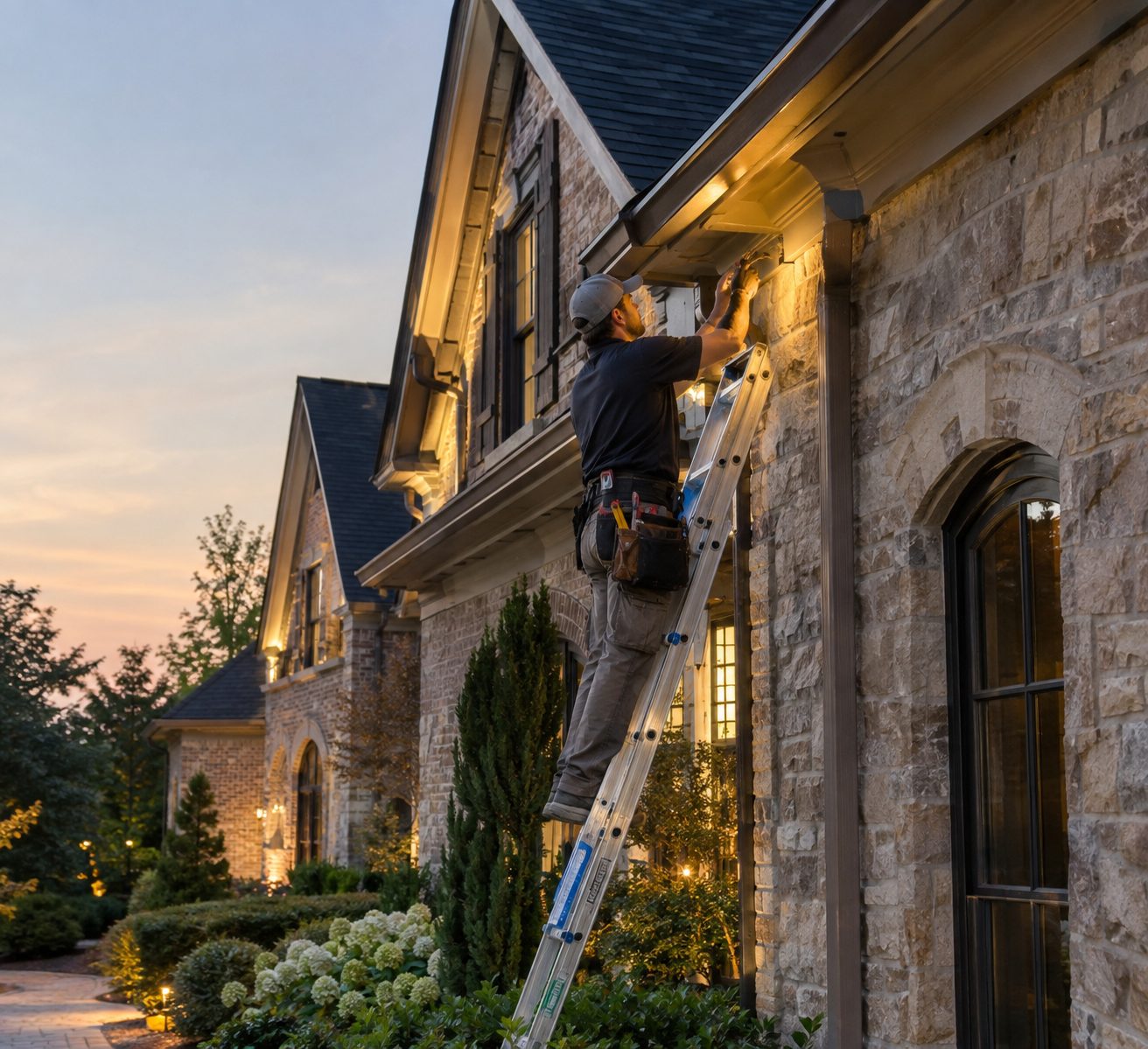
A landscape lighting system is not an appliance you install and forget. It lives outside, in Georgia, in red clay, under trees that grow. That doesn’t mean it’s fragile. A well-built 12-volt system with cast brass fixtures will run for decades. But it drifts. Mulch creeps up over a lens. A tree puts on four feet and grows past its own downlight. A storm nudges an uplight two inches and now it’s glaring into the dining room instead of washing the chimney. None of that is a malfunction. It’s just what happens, and it’s what maintenance is for.
Quick Answer: What Outdoor Lighting Maintenance Covers
| Task | Why it matters | How often |
|---|---|---|
| Re-aiming fixtures | Trees grow, soil shifts, fixtures get bumped. Aim drift is the most common reason a good design stops looking good. | Annually |
| Clearing lenses and housings | Mulch, leaf litter, and pine straw bury lenses and trap heat. | Annually, or after heavy mulching |
| Cleaning glass | Georgia pollen and hard-water spray cut output noticeably. | Annually |
| Checking transformer load | Fixtures added over the years can push a transformer past capacity. | Annually |
| Verifying voltage across runs | Confirms the far end of a long run is still getting what it needs. | Annually |
| Timer and photocell check | Sunset shifts through the year; astronomic timers need to be tracking it. | Twice a year |
| Inspecting connections | Buried splices are where moisture eventually finds its way in. | Annually |
| Trimming growth off fixtures | Shrubs will grow into and over a well light within two seasons. | As needed |
| Bulb replacement under warranty | Covered with no service charge inside the 5-year LED warranty. | As needed |
Maintenance Is Not the Same as Repair
Worth separating, because they’re priced and scheduled differently. Maintenance is planned. It’s a scheduled visit where the system gets tuned back to the way it was designed to look. Nothing is broken. Repair is reactive. Something has stopped doing its job and needs diagnosing. If that’s where you are right now, our guide to common LED lighting issues walks through what’s usually going on, and our replacement lighting page covers the point where repair stops being the economical answer. The distinction matters financially. Systems on a maintenance schedule need far less repair, because aim drift and buried lenses get caught before they become failed connections and dead runs.
What Georgia Specifically Does to Outdoor Lighting
Red clay
Clay expands and contracts more than sandy soil. Over a few seasons that movement tilts staked fixtures and puts tension on buried cable at the stake. It’s the reason aim drift is more pronounced here than in a lot of the country.
Summer storms and water table
Heavy August rain saturates beds and finds any splice that wasn’t properly sealed. Storm-driven limb fall is also the most common cause of physical fixture damage we see.
Hardwood canopy growth
This is the one nobody plans for. A downlight mounted 25 feet up in an oak was aimed for a canopy that no longer exists in that shape. Four years later the light is hitting leaves instead of the lawn. Re-aiming a canopy downlight is a maintenance visit; nothing is wrong with the fixture at all.
Pollen
Spring pollen films over glass and measurably cuts output. It washes off. It just has to actually be washed off.
Do You Need a Maintenance Plan?
Honestly: it depends, and here’s on what. A plan is worth it if you have a large system, mature trees, significant hardscape, or a property where the lighting is doing real work at the street. Also if you simply don’t want to think about it. You can probably skip it if you have a small, recently installed system on flat ground with young plantings, and you don’t mind calling when something looks off. NightVision offers an optional annual maintenance plan. There is also a crew here dedicated entirely to post-installation service — not installers squeezing service calls between jobs. Service calls are grouped geographically and typically handled within 3 days to a week.
How NightVision Handles Outdoor Lighting Maintenance
Two things determine whether landscape lighting maintenance is worth paying for, and neither one is the checklist. The first is who actually shows up. NightVision doesn’t subcontract — consultation, installation, and service are all done by its own trained lighting crews, and there is a crew here assigned entirely to post-installation service rather than installers fitting service calls in between jobs. Walter Taylor, a master electrician on an unrestricted license, is on staff, and the company has been lighting properties around Atlanta and North Georgia since 1998, across more than 5,000 homes. For exterior lighting maintenance that matters more than it sounds: the person re-aiming a canopy downlight has already aimed a few thousand of them.
The second is what’s covered between visits. Under the maintenance contract, replacements are included — a bulb that burns out, a fixture that breaks, or a fixture damaged by accident, including the classic one, a spade through a buried cable during spring planting. Inside the 5-year LED warranty there is no service charge for bulb replacement, and you deal with NightVision directly rather than chasing a manufacturer. Service calls are grouped geographically, so timing depends partly on where you are, but they are typically handled within 3 days to a week. NightVision is a licensed electrical contractor, License No. EN008650.
What Maintenance Costs
It scales with fixture count and property size, the same way installation does. The variables:
- How many fixtures are on the system
- Whether any of them are canopy-mounted and need a climber
- Whether the system is LED under warranty or halogen out of warranty
- Whether it’s a single annual visit or a plan with service included
For how those drivers work across the whole scope of work, see how much outdoor lighting installation costs.
Maintaining a System Somebody Else Installed
We do this regularly, and it’s worth setting expectations. We’ll service another company’s system, but the first visit is partly an assessment: wire gauge, transformer capacity, splice quality, and fixture material. Sometimes the answer is that the system is sound and just needs tuning. Sometimes the honest answer is that the fixtures are aluminum, the runs are undersized, and money spent maintaining it is money you’ll spend again. We’ll tell you which one it is. We have no reason not to — we’d rather do the design properly once.
A Reasonable Annual Rhythm
- Late winter — the best time for a full service visit. Beds are cut back, sightlines are open, and everything is reachable before spring growth.
- Spring — wash pollen off lenses. Check that new mulch hasn’t buried anything.
- Mid-summer — check aim after growth fills in. Confirm timer is tracking sunset.
- After any significant storm — walk the system and look for a fixture that’s moved or a limb that’s landed.
Want us to look at what you have? Ask us to walk the property at dusk — it’s the only time you can actually see what the light is doing. Get in touch. Our FAQ covers warranty and scheduling specifics, and the gallery shows what a tuned system looks like.
Frequently Asked Questions
How often should outdoor lighting be maintained?
Once a year for most systems, ideally in late winter before spring growth fills in. Properties with mature hardwoods or large fixture counts benefit from twice a year, mainly to keep aim correct as canopies change.
Is bulb replacement included in maintenance?
Inside the 5-year LED manufacturer’s warranty, bulb replacement is covered with no service charge, and you deal with NightVision directly rather than the manufacturer. Halogen carries a 1-year warranty, so out-of-warranty halogen bulbs are billed.
Do you offer an annual maintenance plan?
Yes, it’s optional. NightVision also keeps a crew dedicated entirely to post-installation service, separate from the installation crews.
How quickly do you respond to a service call?
Typically within 3 days to a week. Calls are grouped geographically, so response time depends partly on where you are in the service area.
Will you maintain a lighting system another company installed?
Yes. The first visit includes an assessment of wire gauge, transformer capacity, splice quality, and fixture material, so we can tell you honestly whether the system is worth maintaining or whether you’d be better off replacing it.
Does landscape lighting need to be winterized in Georgia?
No. Low-voltage systems here run year-round without seasonal shutdown. Late winter is simply the most practical time to service them, because the plantings are cut back.