
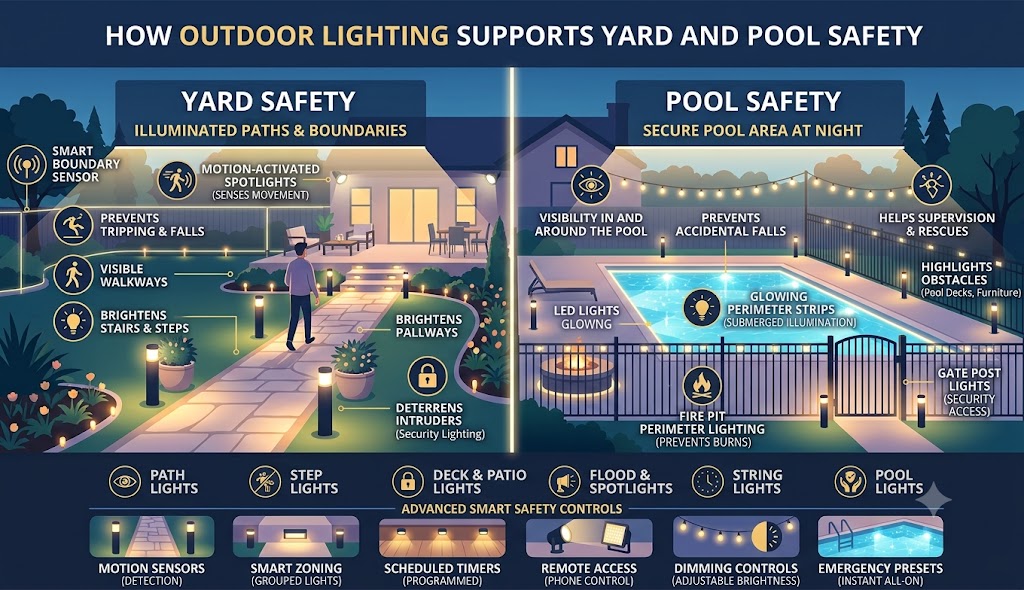
Outdoor lighting can improve visibility around yards, pools, pathways, steps, and gathering spaces after sunset.
For homeowners considering luxury backyard lighting in Milton, GA, a carefully planned system can combine practical illumination with a comfortable and refined nighttime appearance.
This can be especially helpful for households with children, older adults, or frequent guests who may be unfamiliar with the property’s layout. A well-designed system does more than make the backyard brighter.
It places light where people walk and gather while reducing glare, harsh contrasts, and deep shadows.
Around pools and other water features, fixtures and electrical components must also be appropriate for the conditions in which they are installed.
Lighting should support a broader safety plan rather than replace supervision, pool barriers, secure gates, alarms, or regular property maintenance.
The first step is identifying the outdoor locations that need better visibility after dark.
What Does Pool Lighting Include?
Pool lighting covers more than fixtures installed beneath the water. It also includes illumination around the pool that helps connect the water, deck, pathways, and outdoor living spaces.
A complete design may include lighting for:
- The pool interior
- Pool edges and coping
- Decks and wet surfaces
- Steps, ladders, and handrails
- Gates and access paths
- Patios and seating spaces
- Outdoor kitchens
- Landscaping and water features
- Walkways connecting the pool and house
Each location requires a different approach. Underwater fixtures can reveal the pool’s shape, while step, path, and hardscape lights help define walking surfaces and changes in elevation.
The goal is not simply to make the pool brighter. Light should be distributed carefully to improve visibility, control glare, and reduce harsh reflections from the water.
When these elements work together, the pool and surrounding backyard can feel more comfortable, cohesive, and inviting after dark.
Problems With Poor Pool Lighting
A pool may have underwater or decorative lights while the surrounding deck, steps, and walkways remain dark or unevenly illuminated.
Poor fixture selection and placement can also create glare, heavy shadows, and distracting reflections.
Common problems include:
- Dark sections around the pool deck
- Poorly defined pool edges
- Shadows near steps and ladders
- Glare reflected from the water
- Uneven lighting along walkways
- Overly bright fixtures near seating spaces
- Fixtures unsuitable for wet conditions
- Premature damage caused by moisture or corrosion
- Difficult access for cleaning and maintenance
An effective design balances visibility, glare control, visual comfort, and long-term fixture performance. Making every surface as bright as possible can create more visual discomfort rather than a better result.
Why Professional Pool Lighting Installation Matters
Pool lighting involves electricity near water, so fixture selection, wiring, placement, and electrical connections require careful planning.
A professional evaluates the pool, deck, access paths, landscaping, and common viewing positions before deciding where each fixture should be installed. Expert installation helps ensure that:
- Fixtures are appropriate for their intended locations.
- Pool edges, steps, and walking surfaces receive suitable illumination.
- Light does not shine directly into swimmers’ or guests’ eyes.
- Water reflections and glare are carefully controlled.
- Wiring and connections are protected from outdoor conditions.
- Fixtures remain accessible for future maintenance.
- The finished system complements the surrounding landscape.
An experienced backyard lighting contractor in Milton, GA can also test the system after sunset and adjust fixture angles, brightness, and beam direction.
These adjustments are important because glare, shadows, and reflections may not be apparent during daytime installation.
What Does Yard Lighting Include?
Yard lighting includes fixtures installed throughout gardens, lawns, pathways, driveways, patios, and landscaped spaces.
These lights can improve visibility while highlighting plants, trees, architectural details, and other outdoor features.
Common types of yard lighting include:
- Path lights for walkways and garden routes
- Step lights for stairs and elevation changes
- Spotlights for trees, sculptures, and architectural features
- Downlights for illuminating selected spaces from above
- Hardscape lights for walls, patios, and retaining structures
- Motion-activated lights for entrances and activity spaces
Yard lighting systems can use different fixture types, beam spreads, mounting methods, and controls.
A professional can recommend an appropriate combination based on the property’s layout, nighttime views, and lighting goals.
A successful design places light where it serves a clear purpose without making the entire property excessively bright.
Proper shielding and placement can reduce glare and unnecessary light spill while preserving a comfortable nighttime atmosphere.
Because outdoor fixtures are exposed to rain, irrigation, soil, humidity, and changing temperatures, they should be suitable for their installation environment.
Common Challenges With Yard Lighting
Large yards, mature landscaping, sloped surfaces, and multiple outdoor living spaces can make lighting more complicated.
This is particularly relevant to custom backyard lighting in Milton, GA, where residential properties may contain long driveways, established trees, pools, patios, and multiple pathways.
A few randomly placed fixtures may leave some locations excessively bright while others remain difficult to see.
Common challenges include:
- Dark pathways and driveway edges
- Steps that blend into surrounding surfaces
- Uneven lighting across large properties
- Glare from exposed or poorly aimed fixtures
- Deep shadows created by trees and structures
- Light spilling into windows or neighboring properties
- Mismatched fixture styles and color temperatures
- Fixtures becoming covered as plants grow
- Outdoor components deteriorating from moisture or corrosion
An effective design addresses the entire property instead of treating each fixture as a separate addition. Path, step, accent, hardscape, and downlighting should work together to improve visibility while preserving the yard’s natural appearance.
How Can Backyard Lighting Look Luxurious Without Becoming Too Bright?
Luxury outdoor lighting is not determined by brightness or the number of fixtures. It comes from careful placement, visual balance, suitable materials, and a clear hierarchy of focal points.
A layered design may use soft pathway lighting to guide movement, downlighting to illuminate a patio, and focused accent lighting to reveal the structure of a mature tree.
Pool and water-feature lighting can provide another visual layer without overpowering the rest of the backyard.
The design should also complement the home’s architecture and landscape. Warm illumination often works well with brick, wood, natural stone, and established greenery, while controlled beam angles prevent the property from appearing flat or overlit.
Timers, dimmers, photocells, and compatible controls can provide additional flexibility. Different lighting zones can then be adjusted for entertaining, relaxing, or everyday use.
When Should Yard and Pool Lighting Be Maintained?
Yard and pool lighting should be inspected periodically and whenever changes in performance become noticeable.
Landscape growth, severe weather, irrigation, pool chemicals, and ground movement can affect fixture condition, position, and light output.
Maintenance may be needed when:
- Lights appear dim, flicker, or stop working
- Fixtures have shifted or point in the wrong direction
- Glare or unexpected shadows develop
- Plants begin covering fixtures or blocking beams
- Dirt, pollen, or mineral deposits collect on lenses
- Timers, photocells, or controls stop working correctly
- Moisture or visible damage appears around a fixture
- Landscaping, pool, patio, or hardscape work is completed
It is also helpful to review the system after major storms and as part of seasonal landscape maintenance.
Pool lighting may need closer attention during periods of frequent use because moisture, chemicals, and debris can affect nearby fixtures.
Homeowners can clean accessible lenses and trim surrounding plants. Flickering, water intrusion, damaged wiring, or electrical problems near a pool should be evaluated by a qualified professional.
Regular maintenance helps yard and pool lighting continue to perform properly as the property changes.
Plan Your Yard and Pool Lighting Around the Entire Property
Effective outdoor lighting depends on more than selecting attractive fixtures.
Placement, beam direction, glare control, electrical planning, nighttime adjustments, and ongoing maintenance all influence how the finished system looks and performs.
NightVision Outdoor Lighting designs residential outdoor lighting in Milton, GA for pools, patios, pathways, gardens, and complete backyard environments. If you are looking for lighting for pools, yards, or other purposes, you can contact us to discuss a customized design for your property.
Frequently Asked Questions
What are the main safety considerations for pool lights?
Pool lights should be designed for their intended pool or wet-location application. Working GFCI protection, proper bonding and grounding, intact seals, and protected electrical connections are important considerations. Flickering, buzzing, corrosion, or water inside a fixture should receive immediate professional attention.
What is the best type of outdoor lighting for a pool?
An effective design combines appropriate underwater pool lights with low-glare illumination around decks, steps, gates, and walkways. Fixtures should be selected for their exposure to water, moisture, and changing weather. Shielded LED fixtures with controlled beam angles can provide balanced lighting while reducing reflections.
How can outdoor lighting be secured?
Outdoor fixtures should be firmly mounted using wiring, connectors, and hardware suitable for the installation environment. Cables should be protected from water, landscaping equipment, foot traffic, and accidental damage. Extension cords should not be used as permanent wiring, particularly around pools and other wet locations.
What type of lighting should be used in outdoor spaces?
Outdoor spaces generally benefit from a combination of path, step, hardscape, accent, and task lighting. Each fixture should be selected according to its location, exposure, and purpose. Shielded, warm-colored lights and appropriate controls can reduce glare, unnecessary light spill, and energy use.