
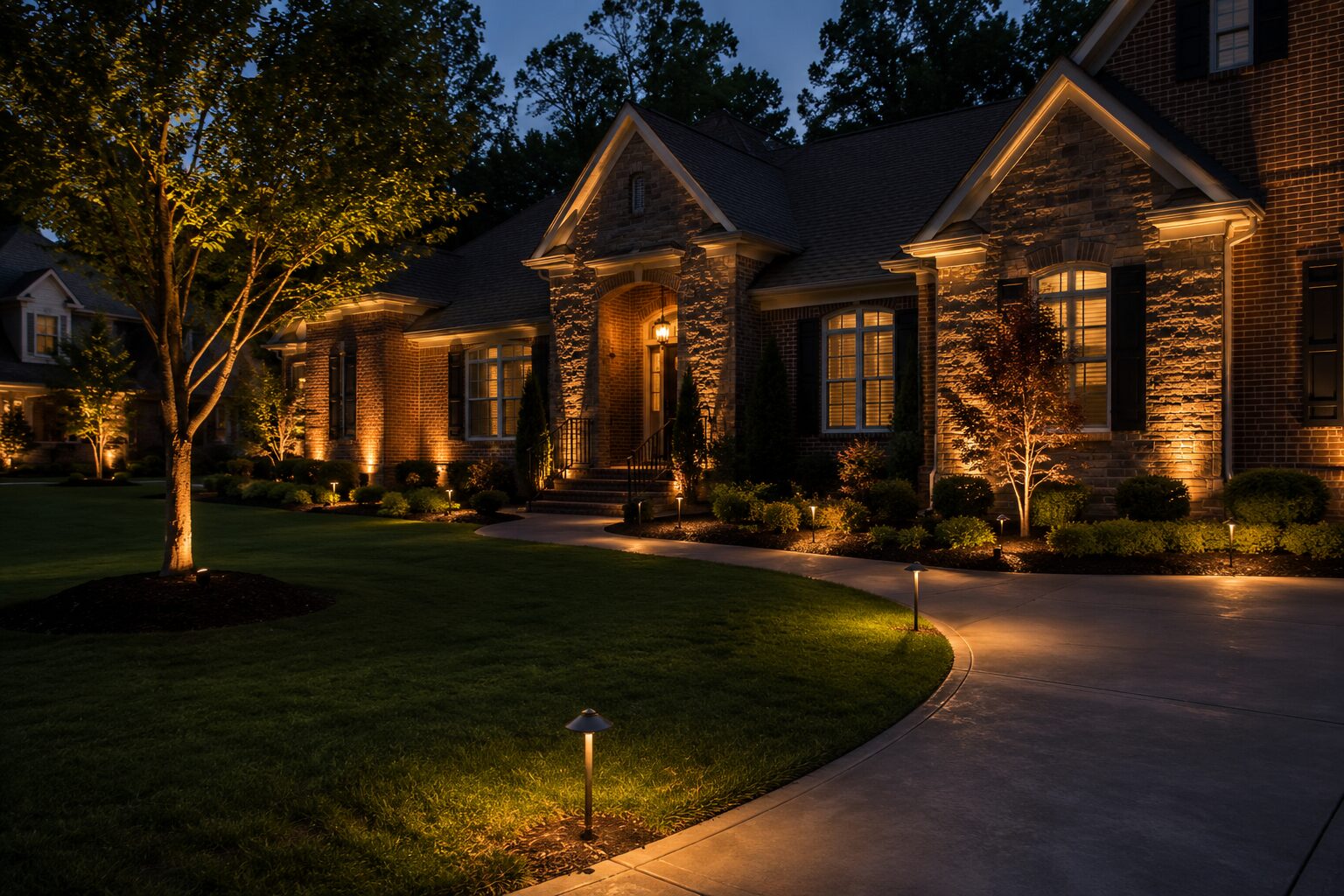
Your home may look welcoming during the day but feel completely different after sunset.
The walkway may be hard to follow, steps can blend into the ground, and the patio may be too dark to use comfortably.
A thoughtful plan for outdoor lighting in Atlanta, GA, can improve these areas without making the entire property overly bright.
The goal is to place useful light where people walk, gather, and spend time.
This guide explains how to identify your lighting needs, choose suitable fixtures, compare lighting systems, and keep everything working as your property changes.
What Should You Know Before Planning Outdoor Lighting?
Outdoor lighting works best when every fixture has a clear purpose.
Some lights help people find their way, while others highlight the home or create a comfortable setting.
Look Around Your Property After Dark
Walk around your property after sunset. Start at the street, move along the driveway, and follow the path to your front door. Then check the side yard, backyard, patio, deck, or pool.
Ask yourself:
- Can visitors find the front door?
- Are the driveway and walkway easy to follow?
- Can you see each step?
- Which areas feel too dark?
- Is the patio bright enough to use?
- Which trees or home features disappear at night?
- Does an existing light shine into a window?
- Is one area much brighter than the others?
This simple check will show you where lighting is helpful and where it is not needed.
Give Every Light a Clear Purpose
One fixture should not be expected to do everything. A bright garage light may illuminate part of the driveway, but it may not reveal the path or a step near the door. Making it brighter could create glare without solving the problem.
A complete plan may include:
- Practical lights for paths, steps, doors, and gates
- Accent lights for trees, walls, and gardens
- Softer lights for patios and sitting areas
- Wiring, connections, and a transformer
- Timers, light sensors, or smart controls
These parts should work together so the property feels connected.
Where Should You Install Outdoor Lighting?
Different parts of the property need different kinds of light. The right fixture depends on what people need to see and how the area is used.
Driveways and Parking Areas
Driveway lighting can show curves, edges, parking spaces, and nearby obstacles.
Fixtures should be placed so they do not shine directly into a driver’s eyes.
Brighter is not always better. A powerful light can cause glare and make the area outside its beam harder to see. Several softer lights in useful locations may provide a clearer view.
The fixtures should also avoid sending light into bedrooms, across the street, or onto nearby properties.
Walkways, Steps, and Changes in Ground Level
Pathway lighting should help people follow the walkway and notice changes in direction. You do not always need a fixture on both sides of every section.
Staggered lights can create a more natural appearance. The correct spacing depends on the path’s shape, nearby plants, fixture height, and how far each light reaches.
Steps need special attention because even one change in height can be difficult to notice. Step lights or fixtures aimed down from above can make these areas easier to see.
Lighting cannot repair a broken step or uneven path, so physical hazards must still be corrected.
Front Doors and Other Entrances
The front door should be easy to find without becoming the brightest part of the property.
Wall lights, overhead fixtures, or controlled downlighting may help visitors see the door, house number, lock, and nearby steps.
Softer, well-placed light often feels more welcoming than a strong floodlight aimed directly at the entrance.
Patios, Decks, and Outdoor Living Areas
Patios and decks need enough light for dining, conversation, and movement, but they should still feel relaxing.
Soft lighting may be used around seating areas, with brighter task lighting near a grill or food-preparation counter.
Deck lights can be placed around stairs, posts, railings, and changes in floor level.
Avoid placing exposed lights at eye level. Even a small fixture can feel harsh when it shines directly toward someone who is seated.
Gardens, Trees, and Home Features
Atlanta homes may have mature trees, brick walls, stone details, columns, or layered gardens.
Outdoor lighting can keep selected features visible at night. You do not need to illuminate every tree or wall. Choose a few features that give the property its character.
A fixture aimed upward can show the height of a tree or column. Light directed down from above can softly illuminate a garden, lawn, or sitting area. A light placed close to brick or stone can reveal its texture.
Leaving some areas darker creates contrast and helps the selected features stand out.
Pools and Water Features
Water reflects light, so poorly placed fixtures can create glare around pools, ponds, and fountains.
The plan should account for paths, gates, deck edges, steps, seating areas, and wet conditions.
Fixtures and electrical parts near water must be suitable for their location and follow applicable safety requirements.
Lighting can improve visibility, but it does not replace pool barriers, secure gates, alarms, or supervision.
How Do You Choose the Right Outdoor Lights?
Choose fixtures based on the light they produce, not only on their appearance. Consider brightness, beam width, light color, and placement.
Select the Right Brightness
Lumens measure light output, but the result also depends on fixture height, distance, surface color, nearby plants, and other light sources. Select the brightness based on the specific area.
Match the Beam to the Feature
Narrow beams work well for columns and small trees, while wider beams can cover walls, large trees, and garden beds. Match the beam width to the size of the feature.
Choose a Suitable Light Color
Warm white light often complements brick, stone, wood, plants, and patios. Cooler light may suit modern surfaces or work areas. Use similar tones throughout the property for a consistent look.
Prevent Glare and Unwanted Light
Position and shield fixtures so they do not shine into people’s eyes, windows, streets, or neighboring yards. The feature should be more noticeable than the light source.
Which Outdoor Lighting System Is Right for Your Home?
Homeowners often compare solar lights with low-voltage wired systems. The right choice depends on where the light will be used and how reliable it needs to be.
Low-Voltage Landscape Lighting
A low-voltage system uses a transformer to reduce the electricity supplied to connected outdoor fixtures. It can provide steady and controlled illumination across several areas.
The system must account for the number of fixtures, power needs, wire length, transformer size, and future additions. A professional installer should handle these calculations and plan safe wiring routes.
LED Lights and Automatic Controls
LED outdoor lights use less electricity than many older lighting types and are available in different brightness levels, colors, and beam widths.
Timers can run the lights during set hours. Light sensors can turn them on after sunset, while smart controls may let homeowners manage separate areas. Landscape accents may turn off earlier, while selected entrance or pathway lights remain on later.
What Should Atlanta Homeowners Consider Before Installation?
Atlanta’s heat, humidity, rain, pollen, wet soil, storms, and fast-growing plants can affect outdoor lighting.
A fixture beneath a covered porch faces different conditions from one installed in an open garden or near a pool. The housing, wiring, connections, and mounting method should suit the exact location.
Plants can also block light as they grow. Lawn crews may move fixtures while mowing, trimming, or adding mulch. Accessible and adjustable fixtures are easier to maintain as the yard changes.
Installation cost may depend on:
- Property size
- Fixture number and type
- Wiring distance
- Transformer needs
- Patios, driveways, and other hard surfaces
- Established plants
- Mounting locations
- Lighting controls
- Existing system repairs
- Future expansion plans
A proposal should explain why each fixture is recommended and what it will illuminate.
Homeowners should also ask how glare will be controlled, whether the system can be expanded, and what maintenance it will require.
HOA and permit requirements may vary by property and project. Confirm the rules that apply before installation begins.
Conclusion
The right outdoor lighting should make your property easier to use without making every corner overly bright.
Each light should have a clear purpose, whether it guides people along a walkway, improves visibility around steps, or brings attention to a favorite part of the landscape.
By considering placement, brightness, weather exposure, and future maintenance, you can create a system that continues to work as your home and yard change.
Ready to See Your Atlanta Home in a New Light?
Do not let dark walkways, hidden landscaping, or an uninviting patio limit how you enjoy your property after sunset.
NightVision Outdoor Lighting can evaluate your outdoor spaces and create a lighting plan that complements your home’s layout, style, and nighttime needs.
Contact us today to start planning outdoor lighting for your Atlanta home.
Frequently Asked Questions
Can outdoor lighting be installed in an existing yard?
Yes, lighting can usually be added to an established landscape. The installer should plan fixture positions and wire routes carefully to limit disturbance to lawns, plants, irrigation lines, tree roots, and hardscaped areas.
Is low-voltage outdoor lighting expensive to operate?
Operating cost depends on the number of fixtures, total wattage, hours of use, and electricity rates. LED fixtures and automatic controls can help prevent the system from running longer than needed.
Should outdoor lighting stay on all night?
Not every light needs to remain on until morning. Landscape and patio lights may turn off earlier, while selected entrance or pathway lights can follow a different schedule based on the homeowner’s needs.
How often should outdoor lights be checked?
Homeowners should inspect the system from time to time and after strong storms or major landscaping work. Fixtures may need cleaning, repositioning, trimming around them, or repairs if their performance has changed.
Can an old landscape lighting system be changed to LED?
Many older systems can be upgraded, but the existing transformer, wiring, connections, fixtures, and voltage should be checked first. Some systems may need more than a simple bulb replacement.
Will outdoor lighting bother my neighbors?
It can if the fixtures are too bright or aimed beyond your property. Proper placement, shields, suitable beam widths, and nighttime adjustments can help keep light focused where it is needed.