
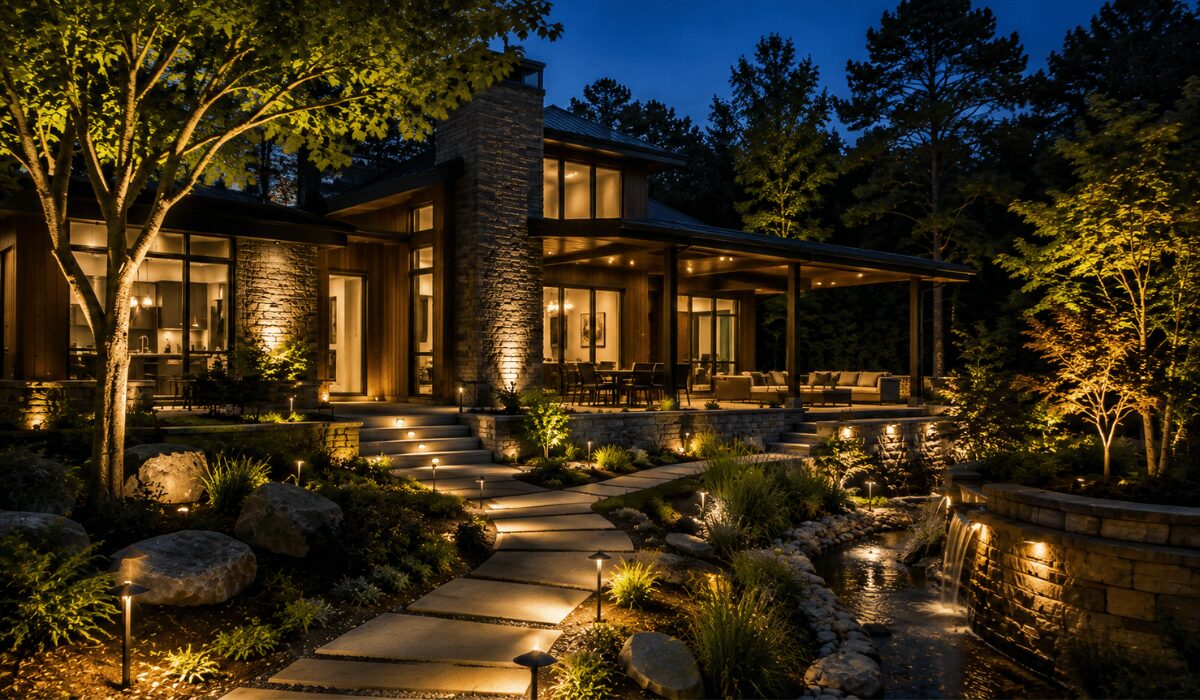
Outdoor lighting can improve your home’s nighttime appearance, provide proper illumination, and allow you to use patios, decks, and other exterior spaces after sunset.
However, good results depend on more than selecting attractive fixtures.
The design, materials, placement, installation methods, and ongoing support can all affect how the finished system looks and performs.
Therefore, choosing the right outdoor lighting company is an important step when you want a system designed for your property.
This guide explains what Atlanta homeowners should review before hiring a provider and which questions can help them make an informed decision.
Why Does Choosing the Right Outdoor Lighting Company Matter?
Installing exterior lights is not simply about placing fixtures around the house.
An effective plan considers the architecture, landscaping, walkways, stairs, outdoor living areas, power requirements, and the atmosphere you want to create.
Poor planning may lead to harsh glare, visible cables, uneven brightness, dark gaps, damaged plants, or unreliable connections.
An undersized transformer may also limit the system or create problems when more fixtures are added.
A qualified provider studies how the entire property looks after dark before recommending a solution.
This detailed approach can help you avoid spending additional money to move fixtures, correct wiring, or redesign the layout later.
Choose a Company That Specializes in Outdoor Lighting
A handyman, electrician, or landscaper may have experience with exterior lights, but you should still ask how often they design complete outdoor systems.
A specialist understands how beam angles, brightness levels, color temperatures, and multiple layers of illumination work together.
They should also know how to size transformers, manage voltage drop, create weather-resistant connections, and position fixtures without producing unwanted glare.
The purpose is not to assume that every general contractor is unqualified.
Instead, confirm that the person you hire has the specific design and technical knowledge required for your project.
Look at the Company’s Experience With Atlanta Homes
Atlanta properties may have mature trees, dense plant beds, sloped yards, long driveways, pools, and large outdoor entertainment spaces.
Brick, stone, siding, and other surfaces can also respond differently when illuminated.
A local outdoor company in Atlanta should understand how the area’s weather, plant growth, and varied property layouts can influence fixture selection and placement.
Ask whether the provider has completed work on homes with features similar to yours.
Relevant local experience makes it easier to create a plan that fits the property instead of applying a standard layout.
Review the Outdoor Lighting Portfolio
A portfolio helps you see the company’s actual work and design ability.
Look for balanced illumination, controlled brightness, consistent color temperature, clearly defined architectural details, and naturally highlighted trees or garden areas.
Paths and steps should be visible without looking like airport runways, and bright beams should not point into windows or people’s eyes.
Do not judge the provider through one impressive photograph.
Review several projects to determine whether its team can adapt to different homes, landscapes, and customer preferences rather than repeating the same arrangement.
Make Sure the Design Is Customized for Your Property
 Every home has different features and lighting needs, so a fixed package may not produce the desired result.
A custom lighting design should consider entrances, driveways, walkways, stairs, patios, decks, pools, gardens, mature trees, and architectural details.
The designer should also ask which spaces you use most often and whether you prefer a soft, welcoming appearance or stronger task illumination in certain areas.
Different fixture types can then be layered to create depth without making the yard excessively bright.
Ask why each fixture is being recommended and what purpose it will serve.
A clear answer shows that the layout has been planned thoughtfully.
Ask About Nighttime Testing and Final Adjustments
Lighting effects are difficult to judge in daylight.
Some providers offer a temporary nighttime demonstration, while others evaluate the permanent system after installation.
Either approach can help reveal incorrect beam angles, unwanted glare, dark spaces, uneven brightness, or light entering a window.
The important point is that the finished layout should be checked after sunset.
Small adjustments to the fixture position or beam direction can make a noticeable difference and ensure the final presentation matches the original goal.
Evaluate Fixture and Component Quality
Low pricing may seem attractive, but fixtures and system components must withstand moisture, heat, temperature changes, lawn care, and regular outdoor exposure.
Ask what materials are used, whether the products are rated for exterior conditions, and if replacement parts will remain available.
The discussion should cover LED lamps or integrated LEDs, cable quality, waterproof connectors, transformer capacity, control options, and the expected life of major components.
You should also find out whether individual parts can be repaired or replaced without removing the entire setup.
Durable materials and correctly sized equipment generally offer better long-term value than choosing products based only on the initial cost.
Check Credentials, Insurance, and Installation Practices
Ask the provider to explain the credentials and insurance it carries for the work being completed.
You should also know whether employees or subcontractors will perform the installation and who will handle any electrical work that may be required.
Discuss how cables will be routed, plants will be protected, and hardscaped areas will be approached.
Existing roots, irrigation lines, patios, and driveways may require additional planning.
A professional installer should explain the process clearly and leave the work area clean once the project is finished.
Compare What Is Included in Each Estimate
Do not compare proposals by looking only at the final price.
One estimate may cost less because it includes fewer fixtures, a smaller transformer, lower-grade materials, or limited support.
A detailed proposal should identify the areas included in the project, fixture types and quantities, transformer specifications, cables, connectors, controls, labor, expected schedule, warranty terms, and possible exclusions.
Ask for clarification when a line item or responsibility is unclear.
Comparing the full scope helps you understand what you will receive and reduces the chance of unexpected charges during the work.
Understand Product and Workmanship Warranties
Product warranties and workmanship coverage are not always the same.
A fixture manufacturer may cover a failed component, while the installer’s warranty may address a problem related to the installation.
Ask what is protected, how long each type of coverage lasts, whether labor is included, and who manages a future claim.
You should also check for exclusions and determine whether routine maintenance is needed to keep the coverage valid.
Request these details in writing so you can review them before approving the project.
Confirm That Maintenance and Repair Are Available
Outdoor fixtures can collect dirt, shift after landscaping work, become hidden by growing plants, or develop damaged connections over time.
Timers and smart controls may also require adjustments when schedules or seasons change.
Maintenance can involve cleaning lenses, repositioning lights, correcting control settings, checking connections, repairing wires, and replacing failed components.
Choosing a reliable outdoor lighting company that provides continued support can make it easier to preserve the original effect as the landscape matures.
Ask how service requests are handled and whether maintenance plans are available.
Consider Energy Use, Controls, and Future Expansion
LED products typically consume less electricity than many traditional bulbs and are available in different brightness levels and color temperatures.
Timers, photocells, smart controls, and separate zones can prevent unnecessary operation while giving you more control over when each area is illuminated.
The recommended setup should match your daily routine rather than include features you will not use.
If you may add a pool, patio, garden, or other feature later, discuss expansion before installation.
Adequate transformer capacity and thoughtful wiring can make future additions easier, although every system has practical limits.
Read Customer Reviews Carefully
An average rating offers a quick impression, but the written comments usually provide more useful information.
Look for repeated feedback about communication, scheduling, design quality, installation cleanliness, problem resolution, and long-term performance.
Reviews that mention warranty work or maintenance can show how the provider supports customers after receiving payment.
Pay attention to how the business responds to concerns as well.
A respectful and helpful response may reveal more about its service approach than the rating alone.
Watch for Warning Signs Before Signing a Contract
A vague estimate, unclear warranty, or pressure to decide immediately should encourage you to ask more questions.
Other concerns may include a lack of completed project examples, no explanation of fixture placement, limited product information, or uncertainty about who will perform the work.
Be cautious when the provider does not discuss glare, nighttime adjustments, landscaping protection, or future service.
One concern does not always mean that a company is unsuitable.
However, several unanswered questions may indicate that you should continue comparing your options before signing an agreement.
Conclusion
Choosing an outdoor lighting company requires more than finding the lowest estimate.
Review the provider’s specialized experience, local portfolio, design process, component quality, installation practices, warranties, and continuing support.
Detailed questions can help you understand the differences between proposals and select a team that matches your expectations.
Talk with NightVision Outdoor Lighting to discuss your Atlanta property and explore a customized plan for its architecture, landscaping, and outdoor spaces.
Why Choose NightVision Outdoor Lighting for Your Atlanta Home?
NightVision Outdoor Lighting+ creates customized systems based on the home’s architecture, landscape, outdoor living areas, and nighttime requirements.
Available solutions include residential landscape lighting, architectural illumination, pathway and garden fixtures, patio and deck lighting, system upgrades, professional installation, repairs, and maintenance.
Each plan focuses on the property instead of using the same arrangement for every customer.
If you are searching for an experienced provider in Atlanta, you can discuss your goals with NightVision Outdoor Lighting and learn which options are suitable for your home.
Frequently Asked Questions
How many outdoor lights does a home need?
The appropriate number depends on the property size, selected features, fixture output, and desired level of brightness.
Adding more lights does not automatically create a better result because placement and beam control are equally important.
Should outdoor fixtures match the style of the house?
Fixture shapes, finishes, color temperature, and overall effects should complement the home’s architecture and landscape.
They do not need to match every exterior detail exactly, but they should contribute to a consistent appearance.
Can outdoor lighting be installed without damaging existing landscaping?
Professionals can plan fixture positions and cable routes to limit disruption to established plants.
The installation method will depend on roots, irrigation lines, garden beds, and nearby hardscapes.
Can a low-voltage lighting system be expanded later?
Many systems can accept additional fixtures when the transformer, wiring, controls, and layout have sufficient capacity.
Discuss possible additions during the initial planning stage so suitable components can be selected.
When is the best time to install outdoor lighting in Atlanta?
Installation can take place during different seasons.
Weather, soil conditions, active landscaping projects, site accessibility, and project complexity may influence the most practical schedule.
Should lighting be planned before the landscaping is completed?
Early coordination can simplify cable routing and help align fixtures with future plants and hardscapes.
However, a skilled installer can also design a system around mature, established landscaping after carefully assessing the property.